
Thursday, September 18, 2014
Paycheck Fairness Act Fails Yet Again.
Two days
ago, the Paycheck Fairness Act failed to pass for the fourth time in the
Senate. The last time (the 3rd time) it was brought to a vote was in
April, earlier this year. The roll call vote, however, passed with a
clear majority of 52-40.Unfortunately, it was 8 votes short of a majority of 60
percent, which is needed to pass in the Senate. The purpose of the bill is to
narrow the earning gap between men and women. According to the U.S.
Census Bureau, so far in 2014, women working full time have made 78 cents to
every dollar than a man makes. This is up very slightly from 2013’s figure of
women making 77 cents to the dollar that men make. Another provision of the act
is prohibiting employers from disciplining employees who wish to share their
income information with other employees. The Act would also work to increase
the legal options for workers who want to fighting income inequalities.
The common theme of the commentary given by the many Republican Senators who voted the measure down was that this was a political stunt by Democrats to appeal to women voters. It’s true that Congress will be recessing soon, and yes, many members will soon return to their home states for the campaign season. Even Senator Deb Fischer, one of the few female Republican Senators refused to vote the bill through because of this issue. Senator John McCain, in particular, saw it was a distraction from the recent international issues in the Middle East with ISIS, and the Defense Authorization Bill.
The common theme of the commentary given by the many Republican Senators who voted the measure down was that this was a political stunt by Democrats to appeal to women voters. It’s true that Congress will be recessing soon, and yes, many members will soon return to their home states for the campaign season. Even Senator Deb Fischer, one of the few female Republican Senators refused to vote the bill through because of this issue. Senator John McCain, in particular, saw it was a distraction from the recent international issues in the Middle East with ISIS, and the Defense Authorization Bill.
Understanding some of the concerns
of the Senators who voted against the bill, I still believe that this level of
income disparity needs more attention from our Congress. While women average 78
cents to a man dollar, that figure gets worse when you factor in an African
American woman’s average of 64 cents to the dollar, or a Latina’s average of 54
cents to the dollar. While this bill won’t entirely solve the work inequality
between the genders and even inequality as a whole, it might prove to be a very
helpful step in that fight.
Here are the full articles on the
topic:

Wednesday, August 27, 2014
Lets keep dated and 'unbecoming' language out of Beacon Hill
Yesterday marked the 94th anniversary of the ratification of the 19th amendment. Ninety-one years ago Democrat Susan Fitzgerald of Jamaica Plain and Republican Sylvia Donaldson of Brockton were the first women in history to be elected to the Massachusetts legislature. We’ve made some progress. Since 2008, Massachusetts has tripled the number of women we send to Congress (from zero to three!) and women serve around 24-percent of the seats in the Massachusetts Legislature. But still, we lag behind most of our neighboring states in New England at electing women to public office. We have to continue to look at the unique obstacles women encounter when they run for office. One of those unique obstacles? Weighted language and rhetoric that is used in the media, in debates, and out on the field that sets us back years. It is dividing statements that change the tone of debate and lead to the pervasiveness of sexism on Beacon Hill.
Just last night in a debate held by The Boston Globe we heard former State Senator and candidate for Attorney General Warren Tolman described his opponent, civil rights attorney and former leader in the Attorney General’s Office Maura Healey as “unbecoming.” Voting history, advertisements, and endorsements aside, the use of the word “unbecoming” has weighted meaning that dates back to before the elections of Susan Fitzgerald and Sylvia Donaldson. Just 12 years ago former Gov. Mitt Romney described his Democratic gubernatorial opponent and former state Treasurer Shannon O’Brien’s behavior as “unbecoming”. Yes, there are times when the word “unbecoming” is used to describe a man’s behavior, but overwhelmingly, it is a way to describe “aggressive” or “bossy” women. Maura Healey is a respected civil rights attorney, a former leader in the Attorney General’s office where she oversaw 250 lawyers and staff members, an advocate for reproductive health rights and consumer protection, a Harvard graduate, and a first-time political candidate who has enlivened voters across the Commonwealth. What she isn’t? Unbecoming.

Friday, August 22, 2014
What We've Been Reading 8/22
According to a new study outlined in a Jezebel article, gender biases continue to pervade perspectives about childcare and work life in the United States. The study, conducted by a Furman University professor, reveals that men who request a flexible work schedule are thirteen percent more likely to be approved than women who do. Furthermore, the study found that a quarter of the male employees were found to be “extremely likeable,” while only three percent of the female employees were seen as “extremely likeable.” Additionally, as a result of making a scheduling request, the female employees were more likely to be seen as “not at all” or “not very” committed. These findings clearly suggest that many people still possess gendered views, wherein it is expected for a woman to complete their second shift of childcare, and men are applauded and rewarded for taking time off for the purpose of childcare. As the article points out, it is important that employees and managers check their biases in the workplace to promote a more egalitarian environment.
An article published last week from The Guardian disclosed the results of a survey exploring motherhood and pregnancy in the workplace. Six out of ten women felt that their careers suffered as a result of their pregnancies, and half of the mothers polled responded that less maternity leave was correlated with them being taken more seriously in the workplace. From a management side, the results are just as troubling. From a group of five hundred managers, thirty three percent revealed that maternity leave and childcare situations with a female employee would result in them hiring a male employee in their twenties or thirties. Four out of ten of the managers would worry about hiring a mother for a starting position or senior role. As these findings suggest, there is much to be done in eliminating the barriers and discriminatory practices that continue to dominate the workplace.
The New York Post ran an op-ed written by Doree Lewak in which she expressed delight in being catcalled by strange men, an article that was critiqued on our blog by MWPC intern Emily Schacter. Also in response to that offensive op-ed, Zerlina Maxwell of mic.com came up with a list of the “10 Dumbest Myths About Feminism, Debunked”. What we’ve learned from the list is that feminism, and being a feminist, is actually OK! Feminists don’t always hate men, they can be funny, they have diverse opinions (even about what feminism means), the idea of feminism doesn’t hurt men and men can be feminists too (GASP!), and feminists can also be moms and wives. Feminists also care about other issues other than abortion, and most importantly, we are not angry. Zerlina’s list is not only funny, but it’s eye-opening, and is worth the read.
MSNBC recently came up with a “30 in 30” featurette which focuses on 30 women candidates to watch in this election cycle. Author Anna Brand notes that “women are at the forefront of many of this year’s critical and most-watched races. From candidates for governorships making waves from red-to-blue states, to game-changing senate seats up for grabs, women are making their voices heard now more than ever.” Equal pay for women, health care, campus sexual assault, and the recent Hobby Lobby decision by the Supreme Court are issues that have rallied women voters, and will most definitely bring them to the polls in November. This could very well be the year of the women, if the number of women state legislatures increases from 24% after the elections and if more women are elected into Congress as well. On Tuesday (day 12), Martha Coakley, the MWPC endorsed candidate for Governor of Massachusetts was interviewed with questions ranging from “What women in politics inspire you?” and “If elected what will be your #1 priority?” You may read the full interview here: http://www.msnbc.com/msnbc/women-candidates-watch-2014-martha-coakley
The Discussion About Street Harassment
There has been a recent online discussion regarding the supposed pros and cons of “catcalling”, also known as street harassment. Generally, this refers to men commenting on womens’ appearances by whistling, calling out, or using sexual gestures. Doree Lewak, a writer for the New York Post, wrote an article expressing her love for catcalling, specifically in the summertime. Her main point was that catcalling is validating, as a man is approving of and complimenting your appearance, including your body and chosen outfit. While she does not support all kinds of catcalling, her general view is that it is a positive experience. I take a great deal of issue with Lewak’s stance, as does Hilary Sargent, writer for Boston.com. Her article, “Lighten Up Ladies, Catcalls Are a Fun Part of Summer,” pokes fun at Lewak and explains why her view is concerning. She notes that a lot of women do not want or need that kind of validation and actually find it demeaning. She also explains that “in a world where women are still underpaid, discriminated against, and consistently victimized by sexual violence, discouraging men from yelling across a busy intersection their thoughts on the sexual attractiveness of a female passerby might actually be something worth discouraging.” Street harassment is still harassment.
In my opinion, it is not empowering for women; rather, it empowers men by making them feel like they have the right to objectify womens’ bodies without any consequences. They can say whatever they want, whether it’s on the street or form their car, using sexual language and gestures, and then go on with their day without having to think twice. For many women, though, the comment will stick with them. As Sargent points out, women face the risk of having a man follow or even sexually abuse them. Catcalls can also be triggering to women who have faced such situations in the past. These men do not know the histories of the women and cannot possibly know how a woman feels about catcalling. Many women, myself included, lose any sense of safety when I am harassed on the street. In short, men need to learn to not harass women. Catcalling cannot be disguised as anything else. It doesn’t matter what she is wearing or how “good” she looks: street harassment should never be an acceptable way to engage with a woman.
Read the full articles:
http://nypost.com/2014/08/18/enough-sanctimony-ladies-catcalls-are-flattering/
by Emily Schacter
Friday, August 15, 2014
What We've Been Reading- 8/15
As we all know “selfies” are a big part of social media and pop culture, and many people see them as narcissistic way to get people to tell them how good they look or as a way for people to judge one another. However, in an article written by Time they examine how women are now turning selfies into a “new kind of empowerment.” For example, Teenage singer Lorde recently posted a selfie in bed with acne-cream on her face and many other celebrities are posting pictures of themselves making silly faces where they are emphasizing their own imperfections. The author, Jessica Bennett, also posted a list of nine ways that selfies are empowering women, including “Selfies Push Back Against Traditional Beauty Norms” and “Selfies Give Girls Control.” A recent survey by Dove found 63% of women believe social media, over print, film, or music, have the biggest impact on the definition of beauty. Bennett says that because teenage girls and young women use social media more than men, women and girls now have more control over the way beauty is defined in our culture. Selfies, Bennett says “force us to see ourselves.. to celebrate what we look like- flaws and all.”
Jessica Valenti at The Guardian wrote about a subject not many women are eager to publicly talk about: feminine hygiene. Even though every woman goes through “that time of the month”, getting your period has such a stigma around it; women often don’t feel comfortable talking about their period (even saying the word out loud is awkward!). But why is this?
Valentin reports: “Gloria Steinem wrote that if men got periods, they ‘would brag about how long and how much’: that boys would talk about their menstruation as the beginning of their manhood, that there would be ‘gifts, religious ceremonies’ and sanitary supplies would be ‘federally funded and free’.”
The social stigma that menstrual periods are dirty and should not be discussed makes it difficult for women who cannot afford the necessary products, like tampons and pads, to get access to them. Food stamps do not cover tampons and pads, forcing some low income women to sell their food stamps in order to buy feminine hygiene products, which the federal government considers “luxuries”. Women in jail also find it difficult to get access to these products as well, even though there are many women in jail, who all get their periods once a month.
Furthermore, the stigma affects young women who are uneducated about feminine hygiene to get informed. Sanitation products are necessary for girls to participate in school, but when they do not have access to affordable products, they must miss school for a week, every month. The UN and Human Rights Watch have “linked menstrual hygiene to human rights”. UNICEF believes 10% of African girls miss school due to lack of access and knowledge of sanitary products. Several charities have begun initiatives to provide products in third world countries, though so long as there is this social stigma regarding menstrual periods, these initiatives will be far and few between.
Like Steinem wrote, if men had their periods, it would be a subject that no boy would feel ashamed bringing up, sanitary products would not be nearly as expensive, and every boy would educated about their menstrual period. For women, the opposite is true. We need to change the talk regarding sanitary products; why shouldn’t female sanitary products be free? Half the population needs access to them every month. The fact that they are not covered for low income people, heavily taxed, and not available to those in jail, is unnerving. Valenti sums up the situation well: “the high cost of a product that half the population needs multiple times a day, every month for approximately 30 years, is simply, well, bullshit.”
Sexist, Misogynistic Tweet by the “Progressive” Bill Maher- Emily Schacter
Short but sweet: Amanda Marcotte, writer at Slate Magazine, wrote a brief but extremely important article pointing out a sexist tweet written by supposedly progressive political commentator. The tweet, as shown below, makes fun of and belittles domestic violence.
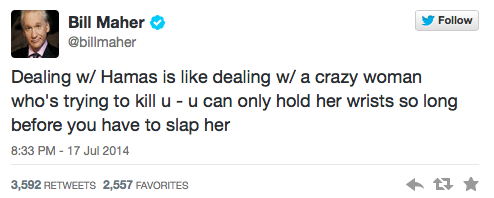
First of all, comparing Hamas to a “crazy woman” is a very inappropriate simile that only makes Maher look bad. In a society where women are described as “crazy” for practically any statement or action driven by the least bit of emotion or passion, the comparison is preposterous.
Marcotte notes that “he’s also trading on the tired stereotype of women as irrational children
who need to be brought in line by more stable men.” Exactly right.
Marcotte notes that “he’s also trading on the tired stereotype of women as irrational children
who need to be brought in line by more stable men.” Exactly right.
The second part of his tweet appropriates domestic violence, as he says that one “must” slap a woman if she will not cooperate or back down. Marcotte points out that “the “who’s trying to kill u” part of the tweet [is] a nice bit of ass-covering that turns domestic violence into self-defense.” He turns the situation around so that the blame is on the woman, per usual. His phrasing therefore insinuates that violence will always be the default when dealing with “crazy” women. This situation is reflective of very real domestic violence that occurs within the United States: One in
every four women will experience domestic violence in her lifetime; An estimated 1.3 million women are victims of physical assault by an intimate partner each year; and 85% of domestic violence victims are women (NCADV). His ignorance is truly disturbing.
every four women will experience domestic violence in her lifetime; An estimated 1.3 million women are victims of physical assault by an intimate partner each year; and 85% of domestic violence victims are women (NCADV). His ignorance is truly disturbing.
Maher’s tweet is also reflective of an underlying misogynistic attitude and sexist belief system in countless men. What is surprising to me is that it’s coming from a supposedly very progressive political commentator. While he may claim to be progressive, and may even be/sound progressive in some ways, this sexist tweet shows something quite different. Even
the most “progressive” or “liberal” people will still continue to use hurtful, demeaning stereotypes to describe women, and even more seriously, joke about violence against women.
the most “progressive” or “liberal” people will still continue to use hurtful, demeaning stereotypes to describe women, and even more seriously, joke about violence against women.
For more information:
Statistics on Domestic Violence:
http://www.ncadv.org/files/DomesticViolenceFactSheet(National).pdf
Subscribe to:
Posts (Atom)
