
Monday, October 27, 2014
What We've Been Reading - 10/27
"Are Women Better Decision Makers?"
This opinion piece in the New York Times explores the
findings of neuroscientists who study decision-making abilities in men and
women. Though men and women make decisions similarly under manageable
circumstances, when stress levels increase, women took less risks than men and
looked instead for “smaller, surer successes.” Companies that have at least one
woman on their boards also do much better than companies who only have males. More
importantly, women have an easier time empathizing with their adversaries than
men in stressful situations, which might mean that if we want to see the end of
political deadlocks in Congress, it would be in everyone’s best interest to put
more women in office.
"Please Put That Can of Soup Down and Put Your Bra Back On"
Breast cancer survivor Leisha Davison-Yasol challenges some of the practices that have come out of Breast Cancer Awareness Month in her article in the Huffington Post. She begins the article by suggesting that perhaps it isn't the best idea to support women with breast cancer with "National No Bra Day," a day she says only reminds her of what she's lost in her battle against cancer. She goes on to talk about how America has commercialized breast cancer and it's has "gotten out of hand." During this month in particular, many companies sell products with pink ribbons on them or special pink labels. However, this article points out that most of these companies don't actually donate any money towards breast cancer, and their pink product labels are used for marketing. None of this means that this month isn't doing great things. Awareness really has increased and there is no longer a taboo around breast cancer. If we want to do more though, we should make sure we buy from companies who really are donating to the cause or we should check out her list of recommended organizations to donate to.
"Please Put That Can of Soup Down and Put Your Bra Back On"
Breast cancer survivor Leisha Davison-Yasol challenges some of the practices that have come out of Breast Cancer Awareness Month in her article in the Huffington Post. She begins the article by suggesting that perhaps it isn't the best idea to support women with breast cancer with "National No Bra Day," a day she says only reminds her of what she's lost in her battle against cancer. She goes on to talk about how America has commercialized breast cancer and it's has "gotten out of hand." During this month in particular, many companies sell products with pink ribbons on them or special pink labels. However, this article points out that most of these companies don't actually donate any money towards breast cancer, and their pink product labels are used for marketing. None of this means that this month isn't doing great things. Awareness really has increased and there is no longer a taboo around breast cancer. If we want to do more though, we should make sure we buy from companies who really are donating to the cause or we should check out her list of recommended organizations to donate to.
"Where Are all the older women in news and current affairs?"
Dorothy Byrne, head of news and current affairs at Channel 4
(the UK), started to realize that the number of women in news and currentaffairs has dramatically decreased. She says there were lots of other women
when she started out in television. She also points out how it seems that both
men and women start in step but then the disparity is increasing and the gap
between them is widening as they approach retirement age. To buttress her
argument, she mentions Women in Journalism where she herself conducted a piece
of research “that found how much men dominated the front pages as well as
expert opinion.” Also, according to her article, women make up 47.5% of the
entire news and current affairs division and fill 37.3% of leadership positions
in network news. Moreover, numerous studies showed that when news and current
affairs producers seek to get an expert to speak they are far more inclined to
find a man to do so (men made 84% of all those quotes as experts).
It is important that women continue to be present in news
and current affairs if we are to have a sincere and full reflection of our
society. Training programs such as Expert Women that was set up in response to
the lack of women is beneficial but not enough. Maybe it is time for Ofcom, the
independent and competition authority for the UK communications industries, to
become involve and to help states other than UK to overcome impediments such as
lack of women in news and current affairs. It is not only the UK; the problem
is, unfortunately, universal.

Friday, October 17, 2014
The Significance of This Year's Nobel Peace Prize
The world
is buzzing about 17-year-old Malala Yousafzai, the youngest person to win a
Nobel Prize of any kind. Having grown up in Pakistan under Taliban occupation,
Malala is no stranger to hardship, but she definitely doesn’t want to get used
to it. In 2008 she started speaking out about girls’ education in Pakistan.
Since then, she has gained fame around the world for her advocacy for peace,
women’s rights, and universal education. In October 2012, the Taliban tried to
assassinate her. Yet, she didn’t even let a gunshot wound to the head stop her
and she has continued her advocacy since her recovery. Just this week, the
Nobel committee gave her the highest form of recognition: a Nobel Peace Prize.
She is not the sole recipient of the prize—she is sharing it with Kailash
Satyarthi, a 60-year-old man from India who is fighting to end child labor.
Malala’s
message has evolved over the years. She eloquently ties together the call for
girls’ education to wider ideals of human rights and peace as she tears down
stereotypes of her culture and religion. In her speeches, she talks about how
the Taliban use the name of Islam to gain power and wealth, when in fact the
religion is based on peace and equality. This is part of the reason why girls
need to be educated. Giving girls the power of pen and paper gives them the
power to fight tyranny and advocate for what is right. The reason why the
Taliban is preventing girls’ education isn’t because of religion or culture,
but because they are afraid of what will happen when girls can start speaking
out. Their fear is justified. Malala is fortunate to have been educated by her
father and she has used the power of writing and speech to make her voice
heard. We can only imagine what can happen when every girl can speak as loudly
as she can.
The Nobel
committee made a wise choice when they chose Malala for the prize. She links
women’s rights to human rights so strongly that no one can doubt the need to
achieve gender equality. Yet they send another message by pairing Malala with
Kailash Satyarthi. The contrast in their age and gender shows that anyone can
fight for equal rights. Furthermore, it is also no mistake that they selected someone
from Pakistan and someone from India. The two countries have been in conflict since
their bloody partition in 1947. Already the two recipients are showing how the
fight for peace transcends conflict and differences.
The Nobel committee is serious
about peace and equality, and their decision to award these two individuals the
Nobel Peace Prize is bringing us one step closer. Hopefully this prize helps
both recipients gain support so they can continue their fight for human rights
and equality.
-Gia Rowley
Friday, October 10, 2014
What We've Been Reading- 10/10
WBUR Analysis: Issues Keeping Governor’s Race Close
The latest WBZ/UMass-Amherst Poll has the Governor’s race tightening. In this piece of analysis from WBUR’s Steve Koczela, breakdowns on key issues are examined. As Coakley’s lead from before the Sept 9 primary is weakening, she is maintaining a lead when it comes to who voters trust to handle health care and education, while Baker has pulled ahead on the economy and taxes.
WBUR: Shaheen, Brown Court Women’s Vote In New Hampshire U.S. Senate Race
This article explores the focus on the women’s vote in the New Hampshire Senate race between former Massachusetts U.S. Sen. Scott Brown and incumbent New Hampshire U.S. Sen. Jeanne Shaheen. Brown is attempting to upset this lead by what the article cites as “women’s disenchantment with President Obama’s foreign policy.” However, as the article explains, Shaheen still leads with women. Women are for Shaheen by more than 10 points and the article cites one poll from last week that had her up by more than 20 points among women.
Politico: House Homestretch: 5 Key Dynamics
This piece from Politico explores what they identify as five key themes to understand about the midterm House races as we head into the final few weeks. First, they explain that Republicans are on offense in many races. Second, star power has been lost for several Democratic candidates. Third, this may be a better year than expected for incumbents. Fourth, the ACA and President Obama aren’t the only focus in these campaigns, but a wider range of issues. By this Thursday the National Republican Congressional Committee had aired 77 TV commercials and 39 of them did not mention the ACA or President Obama. And finally, a theme that rings true every cycle, it’s all about expectations.
“Femvertising”
On October 2, a panel on “femvertising” was held at AdWeek 2014. Nina Bahadur of the Huffington Post writes about the rise of “femvertising,” defined by Samantha Skey, Chief Revenue Officer of SheKnows, as the use of empowering female images and messages in advertisements. Some examples of femvertising she cites are Always’ #LikeAGirl campaign, which seeks to break down harmful stereotypes about the athleticism and capability of girls, and Dove’s Real Beauty Sketches, which focuses on body positivity, although other ads with similar messages exist, such as Pantene Philippines’ #ShineStrong campaign, having garnered over 48 million YouTube views. Bahadur claims that feminist messages in advertising might be making an impact on not only how women view themselves, but also about how they view the company disseminating the advertisement. Some companies use the proceeds from their campaigns to support female-empowering organizations, like LeanIn, Girl Scouts, and Girls Inc. However, the trend of femvertising does not hold unanimously positive consequences, as some companies produce femvertisements without earnestly supporting the cause they claim to. Nonetheless, Bahadur argues that “femvertising is here to stay.”
Women’s Empowerment Conferences
On a similar note, conferences on women’s empowerment have seen an increase in number, write Christine Haughney and Leslie Kaufman. In fact, they may have as much as tripled in the two years alone, with some media companies like The Atlantic, Cosmopolitan, National Journal, and More magazine adding events centered around women’s empowerment and achievement in the workplace. While Haughney and Kaufman include evidence that the number of high-ranking women in business has increased, they also point to the fact that media publications are facing reduced newsstand and advertising sales and consequently hold these ticketed conferences in order to supplement their revenue. With the price of admission to Fortune’s conference at $8,500, this practice raises questions of the intersection of class and gender, although the number of attendees remains nonetheless high, perhaps suggesting, according Debora Spar, President of Barnard College, that we might be in the midst of the third wave of feminism.
Yazidi Village Kidnappings
In early August, 5 women were abducted from their Yazidi village of Kocho, in the Sinjar Mountains of Iraq and taken to the city of Mosul, nearly 100 miles away. They were 5 out of a group of 65 elderly women and 165 unmarried women abducted by the terrorist group, the Islamic State (IS). Yazidi is a faith with pre-Christian roots, primarily practiced in Iraq (though there has been significant immigration to Germany) that IS targets because they consider it too complicated and deviant from “straightforward” Islam. As a result, up to 400,000 Yazidi people have been driven out of their homes into Northern Iraq, and more than 5,000 women have been abducted. The 5 women interviewed for this article report that, in Mosul, a marketplace had been set up in the city center to sell women, with Christian women priced higher than Yazidi women. Some of the women abducted were raped immediately. Of the 5,000, only 43 have returned.
Women in Law
Two women have recently gained top positions at major US law firms. Litigator Jami Wintz McKeon became the first female chair at Morgan, Lewis & Bockius LLP and white-collar litigator Therese Pritchard became the first female chair at Bryan Cave LLP. Given that women account for only ⅓ of lawyers and judges in the country, and only 17% of equity partners at major law firms, the legal profession remains stolidly a boys’ club. Moreover, the number of women who head major law firms is fewer than ten, and only 4% of law firms have women as managing partners, down from 8% in 2008. In light of these statistics, the appointment of litigators Wintz McKeon and Pritchard are all the more significant; they represent the hopes that, in the face of adversity, women can aspire to and can achieve top positions in, not only in law, but also business, academia, etc. Diversity without diminishment of meritocracy is possible, as McKeon says, and the visibility of women in leadership positions is crucial to the empowerment and equality of the sexes.
Steve Harvey Launches Dating Site
Jeff Bercovici of Forbes.com writes that Steve Harvey has launched a “female-friendly” dating site called Delightful, which will promote longer-term relationships. “Women are wired differently,” Harvey says. “Women don’t really want to just date. They want to date with the hope that it leads to a relationship.”While men don’t mind dating several women at once and “playing the field,” he continues, “A lot of women have that biological clock that ticks in them.” Delightful will cater primarily to women, but also to men with a “womanly interest” in settling down. The site will provide tips on “how to be more dateable” for women and “how to properly treat a lady” for men. Though Harvey seems to truly believe he is doing something positive for women, these characterizations of men and women are extraordinarily outdated and offensive. The idea that all women want or need the help of Steve Harvey to find a good man before their “biological clock” runs out is also absurd.
Misogyny and Social Media
A little lengthy but worth the read, the Atlantic’s Catherine Buni and Soraya Chemaly wrote a shocking piece on misogyny and social media. Once largely hidden from view, violence and brutality against women is being exposed on websites like Facebook and Twitter. A report from the research and policy organization Demos found 6 million instances of the word “slut” or whore” on Twitter between 12/26/13 and 2/9/14, and an estimated 20 percent of those tweets appeared to be threatening. These verbal attacks on women, as well as photos and videos of rape and assault, have sparked an important discussion on free speech and misogyny, but the issue persists.
Emma Watson? Jennifer Lawrence? These Aren't The Feminists You're Looking For
This opinion piece by Roxane Gay in The Guardian explores the problem with celebrity feminism. Gay argues that feminism is only accepted when presented in the "right package," referring to celebrities. It is unfortunate that women and men only understand and accept the ideals of feminism when presented by famous figures such as Beyonce and Emma Watson. If this ideal persists, feminism will seem nothing more than a "seductive marketing campaign."
Friday, September 26, 2014
What We've Been Reading - 9/26
In the Boston Globe this week, Shirley Leung called on
gubernatorial candidates to “stop trying so hard” to court the woman vote.
Leung insisted that candidates Baker and Coakley start
focusing on the economy, education, and the environment to attract women
voters. “We’re so much more than just pro-choice or antiabortion,” she writes.
Leung applauded Coakley’s focuses on early education, earned
sick time, and buffer zones, adding that just because she’s the only female in
the race, “Coakley is not taking women for granted.”
Baker has made a few blunders in his attempt for the female
vote. This past summer, he said the Supreme Court’s Hobby Lobby decision
“doesn’t matter” to Massachusetts women, a statement he later retracted. The
other day, he called a television reporter “sweetheart” during an interview. At
one of his Women for Charlie events last week, he avoided campaign issues and
brought his 17-year-old daughter in to emcee the event.
Emma Watson Deals with Negative Consequences After "HeforShe" Launch at the UN
Emma Watson Deals with Negative Consequences After "HeforShe" Launch at the UN
The
Huffington Post’s Emma Gray writes about both the wonderful and horrific events
that followed Emma Watson’s powerful speech on Feminism earlier this week.
Watson, best known from the Harry Potter film series, spoke about fighting for
more women’s rights and a more equal society. She encouraged both women and men
to stand together in this fight. This has spurred the solidarity movement
‘HeforShe.’ Many female and male celebrities took to Twitter to show their
support of both Watson, and the movement. These include Tom Hiddleston and
Forest Whitaker among numerous others.
The positivity did not last long, because the very
next day an internet group, following the success and the effects of Watson’s
speech, threatened to release intimate pictures of her. Though the threat made
to Watson was hollow and was made to drive popularity of the group’s website,
it still caused a lot of pain and upheaval. It is actions like this that
ironically further validates Watson’s call for action. Gray argues the fact “that
a woman’s body can still be used as a weapon against her is exactly how we know
that the gender equality that Watson is using the UN platform to advocate for
has yet to be achieved.”
Gray also enumerates other cases in which other
women have been sexually harassed by strangers and are targeted because they
are interested in improving the female experience. One case relates to Linda
West who in June 2013 debated the part of rape jokes. In return she received
multiple rape threats. Another case is that of Caroline Criado-Perez who campaigned for
a woman to be put on the UK’s £10 bill. She was also
in turn bombarded with rape as well as death threats. Gray states that situations
like these or really just other case of inequality ultimately come down to
power. It’s about keeping current institutions intact and threatening those who
dare to change them. This should however not discourage us but be additional
fuel to work towards gender equality.
30 Most
Dynamic Women Candidates Seeking Office in 2014
MSNBC
introduced ’30 in 30,’ a new series of the 30 most dynamic women candidates
running for office in 2014. Here is a short presentation of these powerful
women:
Maura
Healey (D) is running for office for the first time. She was previously a civil
rights attorney and a prosecutor. Healey: “I’m a foot shorter than my opponent,
but I’m the only professional basketball player in the race.”
Martha Coakley (D) is the first
woman to serve as Attorney General in Massachusetts. Coakley: “We know that a
strong grassroots campaign is not just the best way to win, it’s the only way
to win.”
Both Maura Healey and Martha
Coakley are MWPC PAC-endorsed candidates; the MWPC is very proud of them!
Alison
Lundergan Grimes (D), if elected, would become Kentucky’s first woman Senator.
Interesting facts are that former President Clinton has campaigned for her and
that she is the youngest woman currently serving as secretary of state. Grimes:
“I’ll gladly stack this ‘empty dress’ up against Mitch McConnell’s empty head
any day.”
Emily
Cain (D) is the youngest woman legislator in history to hold the House minority
leader position in Maine. Cain: “I am the only person in this race with a
proven track record of working across the aisle and overcoming gridlock.”
Monica
Wehby (R), if elected, would become the first female Senator from Oregon in 47
years. She was also the first woman to enroll and graduate from the UCLA
neurosurgeon program. Wehby: “The race I want to run is the one that would be
ran regardless of what gender I am.”
Kay
Hagan (D) comes out on top with the women vote, according to the PPP poll, 44%
to 27%. Hagan: “…to the women reading right now, consider this your recruitment
[to run for public office].”
Ann Callis
(D) is the first female chief judge in Illinois’ third Judicial district.
Callis:”I want to be a voice for the thousands of women in our community who
work hard, play by the rules, and still are struggling to get ahead.”
Shelley
Moore Capito (R), if elected, would become the first Republican senator form
West Virginia in more than 50 years and the first female U.S. senator from the
state. Capito: “This is going to be a tough race and West Virginians deserve a
Senator who is going to fight.”
Jeanne Shaheen
(D) is New Hampshire’s first female governor – and first female U.S. senator
from the state – she is the first woman in U.S. history to be elected as both
governor and senator. Shaheen: “My woman colleagues in the Senate inspire me
every day.”
Rebecca
Kleefisch (R) became the first the LG to face and survive a recall attempt.
Kleefisch: “…my time in politics has proven my parents right over and over:
girls are just as good as boys…and at some things…better.”
Wendy
Davis (D) stood for nearly 12 hours on the Senate floor to filibuster an
anti-abortion bill that shut down multiple abortion clinics across Texas.
Davis: “I’m proud to be an elected official who has fought for issues that have
a unique impact on women.”
Amanda
Renteria (D) is the Senate’s first-ever Latina chief of staff. RenteriaL “In
this country, in today’s society, there is no reason we are still fighting
battles of equality.”
Connie
Pillich (D), an Air Force veteran, wishes to protect the state’s pensions and
safeguard Ohio’s tax dollars. Pillich: “In the Air Force, there was never a
Democratic or Republican way to get things done – just the right way."
Aimee Belgrad (D) won her party’s
nomination with 84% of the vote to challenge Republican Tom MacArthur. Belgrad:
“Alice Paul stepped up, spoke out and took risks for what she believed in –
that woman deserved the right to vote. She is a true inspiration.”
Nina Turner (D), if elected, would
be the first African-American candidate elected to a statewide office. Turner:
“All you need to be successful in live: your wishbone to dream big, your
jawbone to speak the truth, and your backbone to persevere through it all.”
Lucy Flores (D) has said, if
elected, she would help every Nevadan not just the privileged few. Flores: “I
don’t have the typical background of most politicians…no matter your past, it
is possible to change your future.”
Mary Burke (D) became the first
woman nominated by a major party for governor of Wisconsin. Burke: “Wisconsin
has everything it takes to have one of the strongest economies, but under Scott
Walker, we’re not even close.”
Cheri Bustos (D) is the first women
elected in the District. Bustos: “Advice to young women looking to pursue
politics is to do what you say you’re going to do. Follow through. Exceed expectations.”
Kate Marshall (D) is the current
Nevada treasurer and was endorsed by EMILY’s List. Marshall: “I’ve been the
only women in almost every room I have worked in…you have to develop thick
skin.”
Kyrsten Sinema (D) has supported
same-sex marriage and women’s rights in Arizona. Sinema: “Don’t listen to the
people who tell you can’t follow your dreams…ignore the haters and go to what
you love.”
Gwen Graham (D) is daughter of
former Florida Governor and former U.S. Senator Bob Graham. Graham: “If there’s
one thing Congress needs more than anything else right now, it’s some common
ground.”
Natalie
Tennant (D) is the first Democratic woman secretary of state in West Virginia
history. Tennant: “A lot has been said about two women running, but it isn’t
about being the first woman, it’s about being the best woman.”
Mia Love
(R), if elected, would become first black Republican in Congress and the first
person of color to represent Utah. Love: “I’m perfectly comfortable with who I
am and what I believe in, and I never allow anyone to put me in a box.”
Maggie
Toulouse Oliver (D) was the youngest female elected official in the state of
New Mexico. Oliver: “It takes a lot of courage to break that glass ceiling…and
there are a lot of naysayers to defy along the way.”
Gina
Raimondo (D) is current general treasurer of Rhode Island. She has faced
criticism and a lawsuit for making changes to the pension system, including
increasing the retirement age. Raimondo: “My mom always said, if you want
something done, ask a busy woman.”
Bonnie
Watson Coleman (D) is the first African-American house majority leader of the
NJ general assembly and first African-American woman to win the democratic
nomination. Coleman: “There has not been a woman elected to Congress in New
Jersey since 1982.”
Alma
Adams (D) points out that North Carolina hasn’t elected a new Democratic woman
to the House in over 20 years. Adams: “I will bring to the role voices of the
people I’ve fought for. Also, my famous hat collection.”
Staci
Appel (D) is running for a U.S. House seat in Iowa, one of only two states that
have not yet elected a woman to Congress. Appel: “This is a big opportunity to
break up a political boys club and finally break Iowa’s glass ceiling.”
Young
Kim (R) is marking the first time voters will be choosing between two women in
the district: her and Sharon Quirk-Silva. Kim: “For the first time ever, voters
will have the choice to choose between two women to represent them in the state
assembly in this area.”
Mary
Landrieu (D) is the first female U.S. Senator from Louisiana and first women to
head the Energy and Natural Resources Committee. Landrieu: “People may not
agree with me, but they know where I stand and that I’ll fight…my opponents
will have a hard time making this case.”
MSNBC’s
’30 in 30’ Women to Watch in 2014 can be found here: http://www.msnbc.com/msnbc/msnbcs-30-30-women-watch-2014
Tuesday, September 23, 2014
Today is National Voter Registration Day
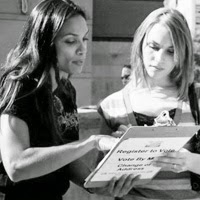
Happy National Voter Registration Day (NVRD)! In 2008, 6 million Americans never cast a vote because they missed a registration deadline or did not know how to register in the first place. NVRD is working to change that in 2014.
Today, volunteers, celebrities, and organizations nationwide are working to raise awareness of voter registration opportunities. The League of Women Voters is sending out volunteers from 400 chapters to hold thousands of voter registration events across the country. If you haven’t registered yet, the deadline in Massachusetts to register for the upcoming General Election is October 15th. For those already registered, do your part on NVRD and encourage a friend to register as well! Studies show that personally asking someone to register and vote is the single most effective method.
For all the information you’ll need to vote, visit www.VOTE411.org. To register in MA, visit http://www.sec.state.ma.us/
This is a high stakes election year for women in Massachusetts – make sure your voice is heard!
Subscribe to:
Posts (Atom)
